Please ensure Javascript is enabled for purposes of website accessibility

A Diwali Reflection on No Kings Day II

The Rev. Abhi Janamanchi offers a reflection in this Diwali season as people gather in cities nationwide to demand freedom from tyranny. #NoKings
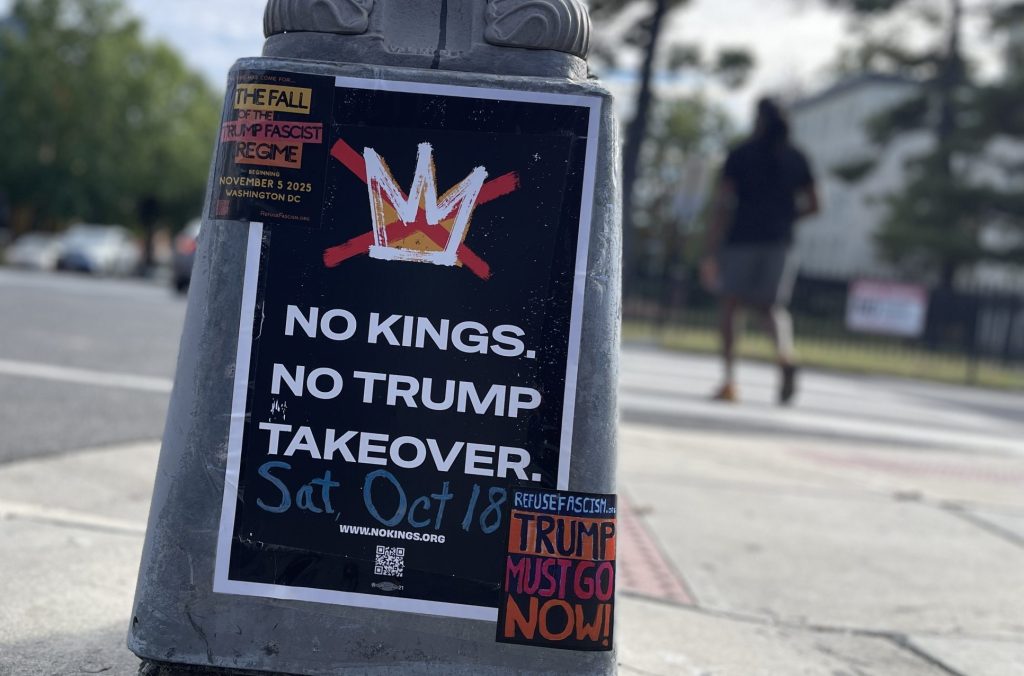
Street scene with a gray pole in the center foreground showing a poster with black background and large white lettering, "No Kings. No Trump Takeover. Sat, Oct 18."
Photo by Lori Stone, seen in the Columbia Heights neighborhood of Washington, DC.

On this No Kings Day II, as people across the country rise to say NO to tyranny,

I find myself remembering an old story told at Diwali.

There once was a king named Naraka – his name itself means hell.

Born of divine parents, he began with promise but lost himself to greed.

Power became his obsession.

He conquered kingdoms, silenced voices, and even sought to rule the heavens.

His cruelty deepened until he imprisoned thousands.

The world trembled under his control.

When power forgets its purpose, even the earth cries out.

And it did.

Krishna answered that cry with his beloved Satyabhama by his side.

Together they entered Naraka’s fortress.

When Krishna was struck down, Satyabhama rose with fierce resolve and faced the tyrant herself.

Together they freed the captives and restored balance.

Their victory was not about conquest but about renewal –

about setting right what had been broken

and remembering what power is meant to serve.

That story is not from another time.

It lives whenever leaders place themselves above truth and conscience,

when greed parades as greatness,

when fear is used to divide,

when compassion is mocked as weakness,

when cruelty masquerades as strength.

But the spirit of Krishna and Satyabhama also lives

wherever people rise with courage and compassion, refusing to submit to tyranny.

It lives wherever the power of love rises to overcome loveless power,

wherever truth steadies trembling hearts

and conscience breaks the grip of fear.

As the Bhagavad Gita teaches:

“Whenever righteousness declines and unrighteousness rises, then I manifest myself.

For the protection of the good, for the destruction of evil,

and for the establishment of what is right,

I come into being age after age.” (Bhagavad Gita 4:7–8)

This is not about gods descending from the heavens —

it is about us rising to answer the call of justice, again and again, in every age.

And Mahatma Gandhi reminds us what that rising looks like:

“Nonviolence is the greatest force at the disposal of humanity.

It is mightier than the mightiest weapon of destruction devised by human ingenuity.

Love is the law of our being.”

We are that force now.

We are that love.

Let us rise together, steady and unafraid.

Let our courage repair what has been damaged.

Let our love restore what power has forgotten.

No kings. Period.

No tyrants. Period.

Only people – equal, free, bound by truth

and led by the love that will not let us go,

let us down,

or let us off the hook.

The struggle is ours.

The love is ours.

Let it live through all we do.

Sarve bhavantu sukhinah,

Sarve santu niraamayah.

Sarve bhadraani pashyantu,

Maa kashchid duhkha bhaag bhavet.

Om Shantih Shantih Shantih.

May all beings be happy.

May all be free from harm.

May all experience what is good.

May no one suffer.

Peace, peace, peace.
Cedar Lane Unitarian Universalist Congregation, located in Bethesda, MD, is a spiritual home for people from many walks of life – seekers, skeptics, longtime believers, and those who aren’t sure what they believe. Some of us find meaning in God, others in nature, human connection, or the mystery of existence itself. What brings us together isn’t one shared belief, but a shared commitment to compassion, curiosity, and putting love into action.

As a Unitarian Universalist congregation, we are guided by values rather than creeds. We believe everyone deserves the freedom to follow their own spiritual path—and that we grow stronger when we honor each other’s stories and identities.

We welcome you to join us for worship in-person or via livestream this Sunday at 10:30 AM ET.

More Posts

The Rev. Dayna Edwards

Surrender as Resistance 

Answering a nationwide call for clergy and people of faith and conscience, Rev. Dayna reflects on her time in Minneapolis for the ICE OUT demonstrations.

The Rev. Abhi Janamanchi

Practicing Resistance

Rev. Abhi explores how remaining open to joy is an important part of practicing resistance in these times.

Share:

Send Us A Message

Sliding Scale Options

suggested love offering of $20 / seat

Sliding Scale Guide

We know it can be complicated to decide how much to pay, and there’s no one right answer for anyone. Many thanks to UU@UN for providing an equitable model for payments.

Consider paying at a lower tier if many of these are true for you:

  • I am directly affected by environmental racism.
  • I have immigration-related expenses.
  • I’m supporting children or have other dependents.
  • I have significant debt.
  • I have medical expenses not covered by insurance.
  • I receive public assistance.
  • I am an elder with limited financial support.
  • I am an unpaid community organizer.
  • I have been denied work due to incarceration history.
  • I would need to budget in order to afford a $25 expense.

Consider paying at a higher tier if multiple of these are true for you:

  • I or my family owns the home I live in.
  • I have investments, retirement accounts, or inherited money.
  • I can travel recreationally.
  • I have access to family money and resources in times of need.
  • I work part time by choice.
  • I have a relatively high degree of earning power due to level of education, gender and racial privilege, class background, etc.
  • In terms of its impact on my lifestyle (e.g. my ability to pay this month’s bills), $50 means functionally about the same as $15. My bank account would look pretty much the same either way.


A reflection from Pronoia Coaching:

When I pay more, I know that I am helping others to access the event.

When I pay in the middle, I know I am helping the organizers cover costs.

And when I pay less, I know I am letting my community hold me and support me.

All of these are wonderful and acceptable ways of participating.