Please ensure Javascript is enabled for purposes of website accessibility

Belonging

Rev. Dayna Edwards encourages us to reflect on how we communicate and cultivate belonging in the congregation while drawing on wisdom from indigenous childrearing practices.
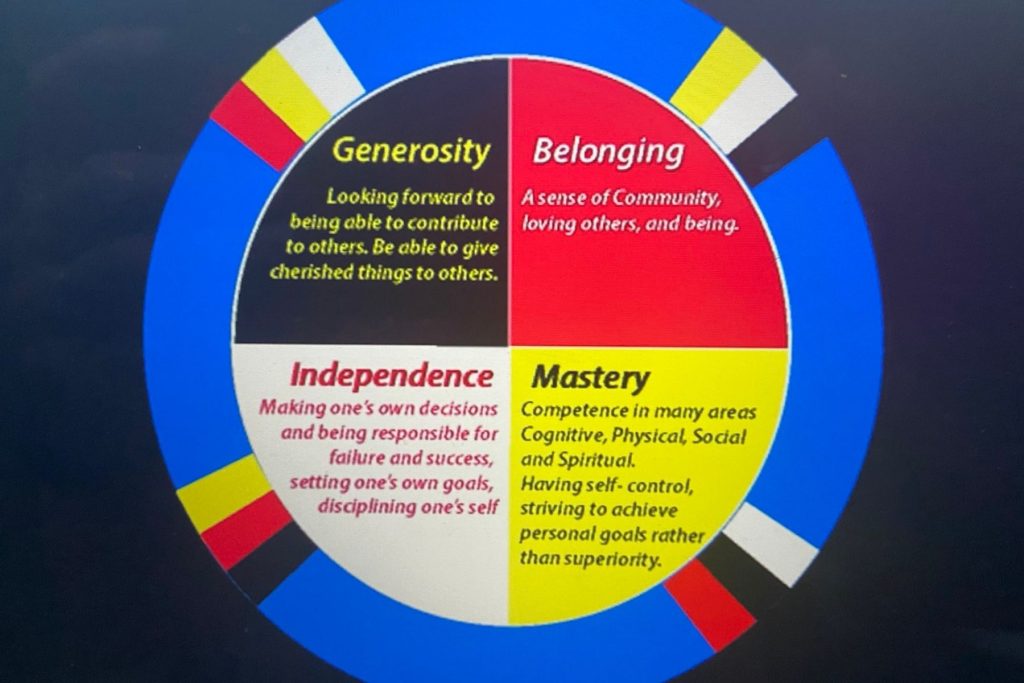
A blue circle divided into four quadrants, labeled clockwise from top left: Generosity, Belonging, Mastery, and Independence.
A visual representation of the Circle of Courage model showcasing the four universal needs for healthy human development: belonging, mastery, independence, and generosity

“We are biologically, cognitively, physically, and spiritually wired to love, to be loved, and to belong. When those needs are not met, we don’t function as we were meant to. We break. We fall apart. We numb. We ache. We hurt others. We get sick.”

— Brené Brown

When I was getting my master’s degree in education, I learned about an indigenous model of childhood development and resilience: The Circle of Courage. This model was based on traditional childrearing practices of Native American and First Nations Peoples and was articulated by Martin Broken Leg, Larry Brendtro, and Steve Van Bockern in their organization Reclaiming Youth International.

In their model, the circle of courage is found and cultivated in every child and there are events that can cause the circle of courage to break – but it can always be repaired. When the circle of courage is broken in the realm of belonging, a person still seeks to belong, but in maladaptive ways – for example joining gangs and cults.

Healthy faith communities are one way we can build belonging in our children and youth AND repair the circle of courage in adults whose sense of belonging has been broken by past events.

As I reflect on Cedar Lane as a community that cultivates belonging I think about how we communicate who belongs. I’m not talking about our words, I’m talking about our unspoken ways of being.

Whose pictures are on the walls?

Whose books are on the bookshelves?

Whose voices are heard in worship and beyond?

Who do we greet and how?

As we begin this new congregational year, and reflect on belonging, I invite you to consider these questions about our faith community in a spirit of joy and generosity, leaving guilt and shame at the door. I am heartened knowing I’m not the only one asking these questions at Cedar Lane. I also know, we as a community are doing our imperfect best and our answers to these questions may vary from day to day.

As the hymn Break Not the Circle says,

Break not the circle of enabling love
where people grow, forgiven and forgiving;
break not that circle, make it wider still,
till it includes, embraces all the living.

May you find belonging in our community and beyond in the wider world.

In faith,
Rev. Dayna

Reflection Questions
from Soul Matters Small Group Materials

  • Some of us live in a place and others of us belong to a place. How does the place you belong to carry your stories, make room for your pain and keep you in touch with your longings?
  • What is the greatest lie that your culture tells you about belonging?
  • Some of us live in a place and others of us belong to a place. How does the place you belong to carry your stories, make room for your pain and keep you in touch with your longings?

Cedar Lane Unitarian Universalist Congregation, located in Bethesda, MD, is a spiritual home for people from many walks of life – seekers, skeptics, longtime believers, and those who aren’t sure what they believe. Some of us find meaning in God, others in nature, human connection, or the mystery of existence itself. What brings us together isn’t one shared belief, but a shared commitment to compassion, curiosity, and putting love into action.

As a Unitarian Universalist congregation, we are guided by values rather than creeds. We believe everyone deserves the freedom to follow their own spiritual path—and that we grow stronger when we honor each other’s stories and identities.

We welcome you to join us for worship in-person or via livestream this Sunday at 10:30 AM ET.

More Posts

The Rev. Dayna Edwards

Surrender as Resistance 

Answering a nationwide call for clergy and people of faith and conscience, Rev. Dayna reflects on her time in Minneapolis for the ICE OUT demonstrations.

The Rev. Abhi Janamanchi

Practicing Resistance

Rev. Abhi explores how remaining open to joy is an important part of practicing resistance in these times.

Share:

Send Us A Message

Sliding Scale Options

suggested love offering of $20 / seat

Sliding Scale Guide

We know it can be complicated to decide how much to pay, and there’s no one right answer for anyone. Many thanks to UU@UN for providing an equitable model for payments.

Consider paying at a lower tier if many of these are true for you:

  • I am directly affected by environmental racism.
  • I have immigration-related expenses.
  • I’m supporting children or have other dependents.
  • I have significant debt.
  • I have medical expenses not covered by insurance.
  • I receive public assistance.
  • I am an elder with limited financial support.
  • I am an unpaid community organizer.
  • I have been denied work due to incarceration history.
  • I would need to budget in order to afford a $25 expense.

Consider paying at a higher tier if multiple of these are true for you:

  • I or my family owns the home I live in.
  • I have investments, retirement accounts, or inherited money.
  • I can travel recreationally.
  • I have access to family money and resources in times of need.
  • I work part time by choice.
  • I have a relatively high degree of earning power due to level of education, gender and racial privilege, class background, etc.
  • In terms of its impact on my lifestyle (e.g. my ability to pay this month’s bills), $50 means functionally about the same as $15. My bank account would look pretty much the same either way.


A reflection from Pronoia Coaching:

When I pay more, I know that I am helping others to access the event.

When I pay in the middle, I know I am helping the organizers cover costs.

And when I pay less, I know I am letting my community hold me and support me.

All of these are wonderful and acceptable ways of participating.