Please ensure Javascript is enabled for purposes of website accessibility

Cultivating Compassion

Rev. Abhi talks about his encounter with the Dalai Lama changed him forever and taught him much about compassion and love.
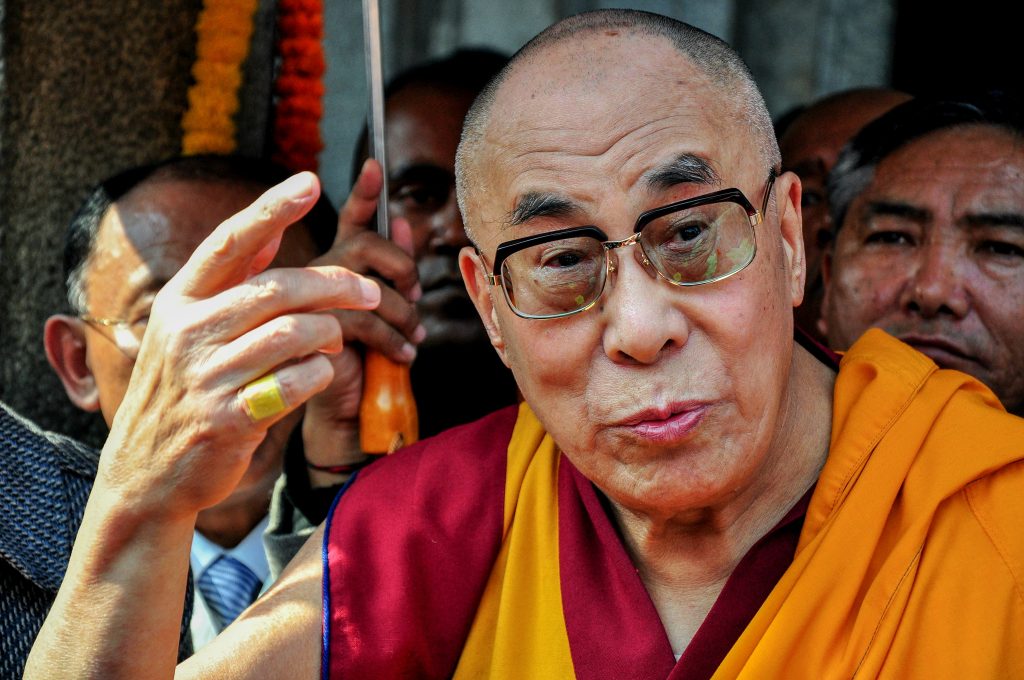
An older baldin man wearing glasses and bright orange and burgandy robes holding up his right hand with children and adults in the background
Photo by Norbu GYACHUNG on Unsplash

“Hold yourself as a mother holds her beloved child.”

— The Buddha (Karaniya Metta Sutta)

In the summer of 2009, I had the joy of spending almost half a day in the presence of His Holiness the Dalai Lama at an international gathering. At the last minute, I was asked to summarize his keynote and then moderate a dialogue with him and other religious leaders. Even now, I get goosebumps remembering the moment when I first met him. Lalitha and I were standing in a crowded hotel lobby when he finally arrived. One by one, we were invited to greet him. When my turn came, I bowed and offered a silk scarf. He placed it gently back on my shoulders, then pulled me close until our foreheads touched. Looking me in the eye, he said, “I am so glad to meet you. I look forward to seeing you again.”

 In that instant, everything else disappeared. I felt held in a love that was tender and radiant, steady and unconditional. It was as if compassion itself had wrapped its arms around me.

What has stayed with me just as deeply is his laughter – rich, belly-shaking, filled with joy. Here is someone who lost his homeland, who carries the grief of his people’s suffering, and yet he laughs. Not because he is naïve or blind to injustice, but because his compassion frees him to live with joy even in the midst of sorrow.

Compassion, the Dalai Lama reminds us, begins with ourselves. To live awake is to hold ourselves as a mother holds her beloved child: tenderly, fiercely, without letting go. From there, compassion ripples outward: to family and neighbor, even to those we find hardest to love. This is not easy work. But it is the way of awakening, and the path that allows us to embody the love that will not us go.

In faith,
Rev. Abhi Janamanchi

Reflection Questions from Soul Matters Small Group Materials

  • If asked, would your family members say you are good at being compassionate with yourself?
  • If you could magically find a way to be more compassionate with one person in your life, who would it be? And why?
  • Tell me about a time when you were offered compassion in an unexpected or unique way.
Cedar Lane Unitarian Universalist Congregation, located in Bethesda, MD, is a spiritual home for people from many walks of life – seekers, skeptics, longtime believers, and those who aren’t sure what they believe. Some of us find meaning in God, others in nature, human connection, or the mystery of existence itself. What brings us together isn’t one shared belief, but a shared commitment to compassion, curiosity, and putting love into action.

As a Unitarian Universalist congregation, we are guided by values rather than creeds. We believe everyone deserves the freedom to follow their own spiritual path—and that we grow stronger when we honor each other’s stories and identities.

We welcome you to join us for worship in-person or via livestream this Sunday at 10:30 AM ET.

More Posts

The Rev. Dayna Edwards

Surrender as Resistance 

Answering a nationwide call for clergy and people of faith and conscience, Rev. Dayna reflects on her time in Minneapolis for the ICE OUT demonstrations.

The Rev. Abhi Janamanchi

Practicing Resistance

Rev. Abhi explores how remaining open to joy is an important part of practicing resistance in these times.

Share:

Send Us A Message

Sliding Scale Options

suggested love offering of $20 / seat

Sliding Scale Guide

We know it can be complicated to decide how much to pay, and there’s no one right answer for anyone. Many thanks to UU@UN for providing an equitable model for payments.

Consider paying at a lower tier if many of these are true for you:

  • I am directly affected by environmental racism.
  • I have immigration-related expenses.
  • I’m supporting children or have other dependents.
  • I have significant debt.
  • I have medical expenses not covered by insurance.
  • I receive public assistance.
  • I am an elder with limited financial support.
  • I am an unpaid community organizer.
  • I have been denied work due to incarceration history.
  • I would need to budget in order to afford a $25 expense.

Consider paying at a higher tier if multiple of these are true for you:

  • I or my family owns the home I live in.
  • I have investments, retirement accounts, or inherited money.
  • I can travel recreationally.
  • I have access to family money and resources in times of need.
  • I work part time by choice.
  • I have a relatively high degree of earning power due to level of education, gender and racial privilege, class background, etc.
  • In terms of its impact on my lifestyle (e.g. my ability to pay this month’s bills), $50 means functionally about the same as $15. My bank account would look pretty much the same either way.


A reflection from Pronoia Coaching:

When I pay more, I know that I am helping others to access the event.

When I pay in the middle, I know I am helping the organizers cover costs.

And when I pay less, I know I am letting my community hold me and support me.

All of these are wonderful and acceptable ways of participating.