Lately, I have been holding the tension of two complex spiritual concepts: surrender and resistance. Surrender is my spiritual practice for this season. I am learning to release what I think “should” be and embrace what is. Resistance is what I feel called toward in this political moment in our nation’s history. Until last week, I struggled to integrate my spiritual practice of surrender with the visceral need in my body to resist fascism and injustice.
In On Tyranny, Timothy Snyder calls us to “practice corporeal politics,” in our resistance to fascism. He says: “Power wants your body softening in your chair and your emotions dissipating on the screen. Get outside. Put your body in unfamiliar places with unfamiliar people. Make new friends and march with them.”
When the call came from MARCH (Multiracial, Anti-Racism, Change and Healing), to assemble in Minneapolis to support the resistance to ICE and provide a faithful moral witness, I knew I had to go. I didn’t go to save anyone, or to be a superhero, or to give ICE a piece of my mind, or even to blow whistles. I went to Minneapolis to support the deep and vast network of organizers who I knew were already doing the work on the ground. I went to Minneapolis to listen and learn from organizers on the frontlines there and return to share my learning with organizers on the frontlines in my own community. I went to Minneapolis to bear moral witness to what was happening and to let those on the ground know they are not alone in the struggle.
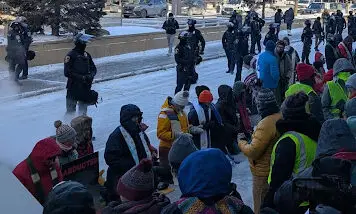
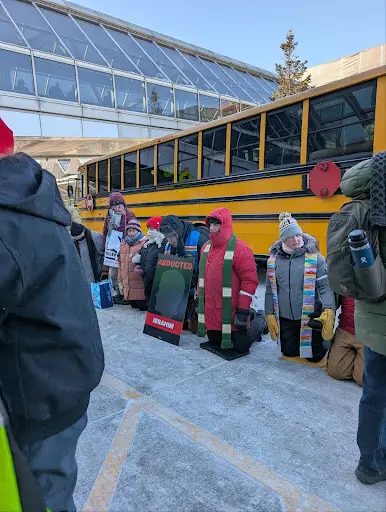
Yet, as I sat on the plane, met with colleagues, settled into my homestay, and prepared for the day of action and general strike on Friday, I couldn’t square resistance with my spiritual practice of surrender. How could I surrender and resist at the same time? I held this tension as I got wrapped up in four layers of clothing, two scarves, two hats, two pairs of socks, gloves and mittens. And I held this tension as we arrived at our morning action: shutting down the airport roadway at the Minneapolis/St. Paul airport. This was an especially important action because 100 interfaith clergy and faith leaders were putting their bodies on the line to shut down the roadway.
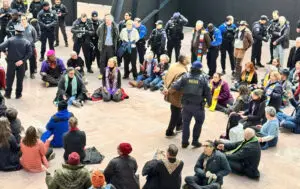
It started like any other action I have been to, chanting, marching, songs, signs. And then the clergy, my beloved colleagues, started lining up, backs turned to the police, some holding hands, some locked arm-in-arm.
And then, they kneeled.
There they were, backs to the very people who had inflicted state-sanctioned violence days before, kneeling, eyes closed, deep in prayer.
In that moment, surrender became resistance.
In that moment, their bodies communicated surrender and their spirits communicated resistance. In that moment, I was moved to tears by their courage, their spiritual fortitude, and their commitment to their values. In that moment, the energy shifted from rage to support. The crowd knew almost instinctively, our goal was to support these humans who prayed while, one by one, they were escorted to a school bus and their hands were put in zip-ties. And all of this happened when the temperatures were -20 degrees Fahrenheit.
My heart is filled with gratitude for my interfaith colleagues that day who taught me that surrender and resistance are part of a both/and, wrapped up in each other. My heart is also filled with gratitude for the village that made my trip possible, people who shared their resources, picked up the slack, and waited patiently for responses. It all matters. It all makes a difference. It is all part of the movement.
Prayer
God of many names and beyond naming,
The world is a scary place right now for so many.
And still grace surrounds us in small acts of love, support, and kindness.
Help us practice surrender in ways that resist tyranny.
Help us engage in resistance as a spiritual practice.
Help us embody corporeal politics in ways that are safe and meaningful.
May we savor the moments of human connection in a world that tries to keep us disconnected.
May it be so.